

Project name
Encouraging Sustainable Choices Among Young VET Learners
Project number
2025-1-LV01-KA210-VET-000355287
Purpose of the project
The Sustainable Advocates project aims to address the environmental and social consequences of fast fashion consumption among young vocational education and training (VET) learners. The project supports these learners by providing them with the knowledge, skills, and motivation to make sustainable consumer choices.
Project implementation period
01.09.2025. – 30.11.2026.
Project budget
60 000,00 €
Project partners:
- Valmiera Development Agency (Latvia)
- Sustainability InnoCenter (Sweden)
- WeLearn Limited (Ireland)
Project target audience
Young Vocational Education and Training (VET) learners (Aged 18-25). Policymakers and stakeholders – policymakers, VET educators, industry professionals and advocacy organisations
Results
- Increased awareness among young VET learners on the environmental and ethical impacts of fast fashion.
- Behavioural change, with participants reducing fast fashion consumption through the No Fast Fashion Challenge.
- High-impact educational materials, including 6 infographics and 9 policy briefs.
- Broad dissemination, reaching 300+ stakeholders and influencing sustainability integration in VET curricula.
Main activities of the project
- Educate young VET learners about the negative effects of fast fashion on climate change, resource depletion, waste, and exploitative labour practices.
- Highlight the contradictions between consumer behaviour and sustainability values, encouraging critical thinking about personal consumption habits.
- Deliver an interactive “No Fast Fashion Challenge”, encouraging VET learners to reduce their fast fashion consumption over 30 days and document their experiences.
- Support VET providers in adapting curricula to include sustainability-relevant skills by providing them with a toolkit of infographic resources to raise awareness of consumer responsibility among their learners.
- Develop policy briefs with recommendations for integrating sustainability into consumer education sectors.
Contacts
Unda Blaumane, +371 28355828, unda.blaumane@valmierasnovads.lv
Funded by the European Union. Views and opinions expressed are however, those of the author(s) only and do not necessarily reflect those of the European Union or The State Education Development Agency (hereinafter – VIAA). Neither the European Union nor the granting authority (VIAA) can be held responsible for them.
RELATED ARTICLES
Discover Newsletter #2 of the Erasmus+ Project “Sustainable Advocates”!
We are excited to share the second edition of the Sustainable Advocates newsletter! Supported by…

Our First Sustainable Advocates Newsletter Is Here!
We’re excited to launch the first newsletter of the Sustainable Advocates project — an Erasmus+…
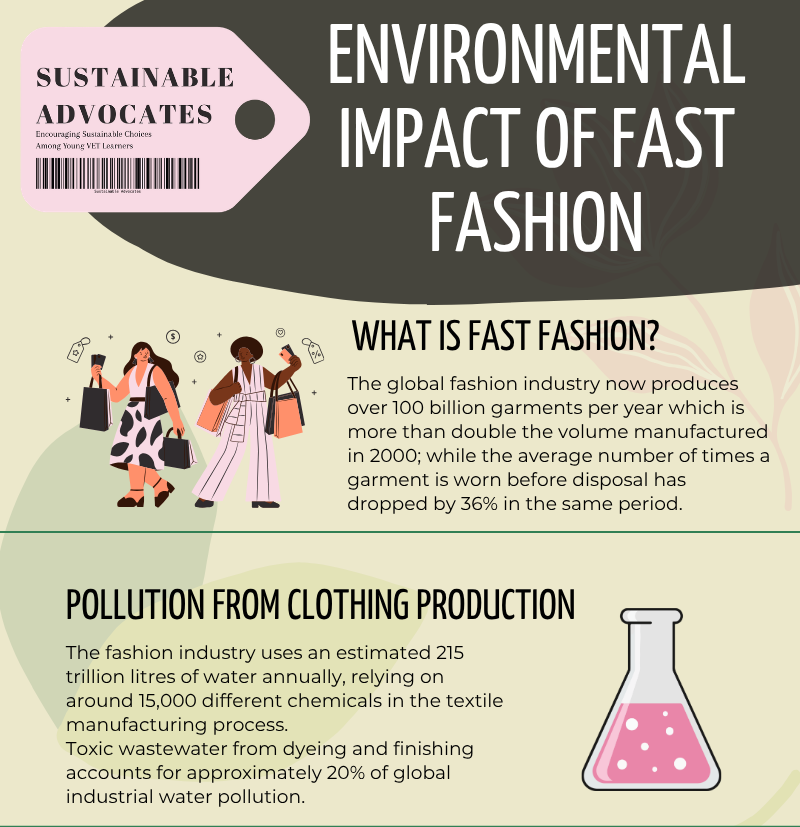
Think before you wear: 6 visual guides to smarter fashion choices
As part of the Sustainable Advocates project, partners have created a series of 6 educational…

Project Partner Meeting in Uppsala
The Transnational Partner Meeting held in Uppsala, Sweden, on 16-17 April 2026, served as a…
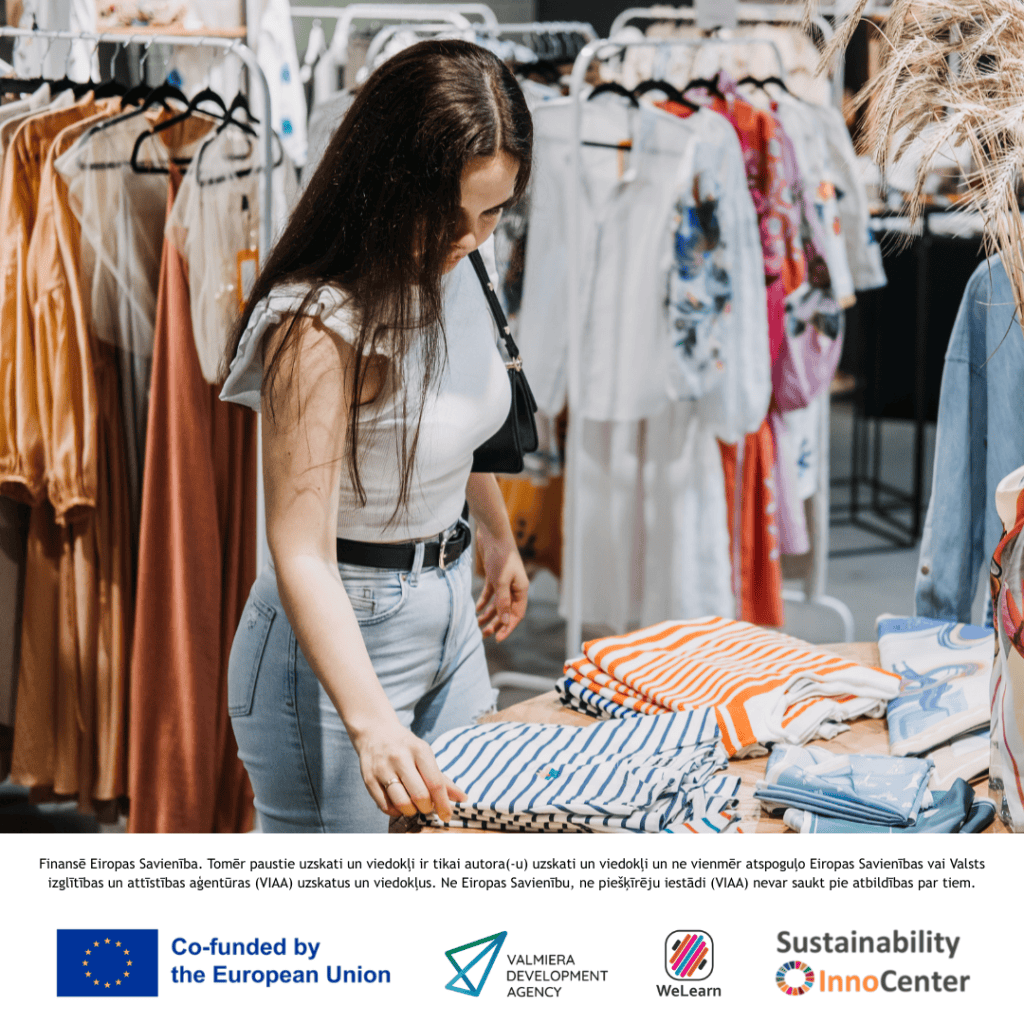
New Erasmus+ project helps young people make more sustainable fashion choices
Photo by the blowup on Unsplash Fast fashion is one of today’s major environmental and…
List of References
Infographic 1 – Environmental Impact of Fast Fashion
- Ellen MacArthur Foundation (2017) A new textiles economy: Redesigning fashion’s future. Cowes: Ellen MacArthur Foundation. Available at: https://www.ellenmacarthurfoundation.org/a-new-textiles-economy (Accessed: 24 April 2026).
- European Parliament (2024) Fast fashion: EU laws for sustainable textile consumption. Strasbourg: European Parliament. Available at: https://www.europarl.europa.eu/topics/en/article/20201208STO93327/the-impact-of-textile-production-and-waste-on-the-environment-infographics (Accessed: 26 April 2026).
- Geneva Environment Network (2024) Environmental sustainability in the fashion industry. Geneva: Geneva Environment Network. Available at: https://www.genevaenvironmentnetwork.org/resources/updates/sustainable-fashion/ (Accessed: 26 April 2026).
- McKinsey & Company (2016) Style that’s sustainable: A new fast-fashion formula. New York: McKinsey & Company.
- one5c (2024) Fast fashion and textile waste statistics and facts. Available at: https://one5c.com/fast-fashion-waste-statistics-136976065/ (Accessed: 24 April 2026).
- United Nations Environment Programme (UNEP) (2024) Sustainable fashion to take centre stage on Zero Waste Day. Nairobi: UNEP. Available at: https://www.unep.org/technical-highlight/sustainable-fashion-take-centre-stage-zero-waste-day (Accessed: 24 April 2026).United Nations Framework Convention on Climate Change (UNFCCC) (2018) UN helps fashion industry shift to low carbon. Bonn: UNFCCC. Available at: https://unfccc.int/news/un-helps-fashion-industry-shift-to-low-carbon (Accessed: 26 April 2026).
Infographic 2 – Ethical Issues in Fast Fashion
- Fashion Revolution. (2020). Do You Know How Much Garment Workers Really Make? https://www.fashionrevolution.org/usa-blog/how-much-garment-workers-really-make/ (Accessed 2026-04-20).
- International Labour Organization. (2023). How to achieve gender equality in global garment supply chains. https://webapps.ilo.org/infostories/en-GB/Stories/discrimination/garment-gender.html#introduction (Accessed 2026-04-20).
- Institute for Human Rights and Business. (2023). Rana Plaza 10 Years On – Lessons for Human Rights and Business. https://www.ihrb.org/resources/briefing-rana-plaza-lessons-for-human-rights-business (Accessed 2026-04-20).
- UNICEF. (2020). Children’s rights in the garment and footwear supply chain. https://www.unicef.org/reports/childrens-rights-in-garment-and-footwear-supply-chain-2020 (Accessed 2026-04-20).
Infographic 3 – Sustainable Fashion Alternatives
- Arnika, Karolina Brabcova. (2024). Toxic chemicals in underwear? Women are a high-risk group when looking for bisphenols in textiles. https://arnika.org/en/news/toxic-chemicals-in-underwear-women-are-a-high-risk-group-when-looking-for-bisphenols-in-textiles (Accessed 2026-04-07)
- Nachhaltige Wäsche, Blazej Kupec. (2022). Your Complete Guide to Understanding Care Labels. https://blog.planetcare.org/de/complete-guide-clothing-care-labels/ (Accessed 2026-04-07)
- Global Commons, Kathleen Fernandez. (2023). Sustainable Alternatives to Fast Fashion. https://earth.org/sustainable-alternatives-to-fast-fashion/ (Accessed 2026-04-07)
- Africa Americas Asia Europe Oceania, Francine Vito. (2022). Explainer: What Is Slow Fashion and How Can You Join the Movement? https://earth.org/what-is-slow-fashion/ (Accessed 2026-04-07)
- Global Commons, Martina Igini. (2023). How to Recognise Fast Fashion Brands and Which Ones to Avoid. https://earth.org/fast-fashion-brands-to-avoid/ (Accessed 2026-04-07)
- Bank of Latvia, Agnese Puķe. (2025). The global overproduction of clothing and a depressing fact. https://www.makroekonomika.lv/raksti/pasaule-sarazoto-apgerbu-un-depresivu-faktu-parprodukcija (Accessed 2026-04-07)
- Bank of Latvia, Agnese Puķe. (2025). Portraits of European and Latvian clothing consumers and textile manufacturers. https://www.makroekonomika.lv/raksti/eiropas-un-latvijas-apgerbu-pateretaja-un-tekstilizstradajumu-razotaja-portreti (Accessed 2026-04-07)
- Bank of Latvia, Agnese Puķe. (2025). Growth in the resale of luxury goods. https://www.makroekonomika.lv/raksti/dizzimolu-precu-talakpardosanas-dizaugsme (Accessed 2026-04-07)
- Oxfam GB, Lara Rice. (2025). 7 Alternatives to Fast Fashion. https://www.oxfam.org.uk/oxfam-in-action/oxfam-blog/alternatives-to-fast-fashion/ (Accessed 2026-04-07)
- ZERO WASTE Latvija, Laila Ābena. (2025). Focus on textiles: Can clothing be toxic? https://www.zerowastelatvija.lv/post/uzmaniba-tekstilam-vai-apgerbs-var-but-toksisks (Accessed 2026-04-07)
- ZERO WASTE Latvija, Laila Ābena. (2025). Focus on textiles: What’s in the teddy bear’s belly? https://www.zerowastelatvija.lv/post/uzmaniba-tekstilam-kas-lacitim-vedera (Accessed 2026-04-07)
- Zaļā brīvība, Article: “A Study on the Sorting and Use of Household Textiles in Latvia”. https://wastetoresources.kem.gov.lv/jaunumi/petijums-par-majsaimniecibu-tekstila-skirosanu-un-izmantosanu-latvija (Accessed 2026-04-07)
- Zaļā brīvība, Dace Akule, Ulla Milbreta, Jānis Brizga. (2023.) Study: “Sorting and Sustainable Use of Household Textiles in Latvia”. https://wastetoresources.kem.gov.lv/storage/deliverables/zala-briviba_majsaimniecibu_tekstila_skirosana_un_ilgtspejiga_izmantosana_latvija.pdf (Accessed 2026-04-07)
Infographic 4 – How to Build a Sustainable Wardrobe
- Global Commons, Martina Igini. (2023). How to Recognise Fast Fashion Brands and Which Ones to Avoid. https://earth.org/fast-fashion-brands-to-avoid/ (Accessed 2026-04-14)
- Bank of Latvia, Agnese Puķe. (2025). Portraits of European and Latvian clothing consumers and textile manufacturers. https://www.makroekonomika.lv/raksti/eiropas-un-latvijas-apgerbu-pateretaja-un-tekstilizstradajumu-razotaja-portreti (Accessed 2026-04-14)
- Oxfam GB, Lara Rice. (2025). 7 Alternatives to Fast Fashion. https://www.oxfam.org.uk/oxfam-in-action/oxfam-blog/alternatives-to-fast-fashion/ (Accessed 2026-04-14)
- Global Commons, Kathleen Fernandez. (2023). Sustainable Alternatives to Fast Fashion. https://earth.org/sustainable-alternatives-to-fast-fashion/ (Accessed 2026-04-14)
- Nachhaltige Wäsche, Blazej Kupec. (2022). Your Complete Guide to Understanding Care Labels. https://blog.planetcare.org/de/complete-guide-clothing-care-labels/ (Accessed 2026-04-14)
Infographic 5 – Fast Fashion vs. Sustainable Fashion
- Geneva Environment Network. (2025). Environmental Sustainability in the Fashion Industry. https://www.genevaenvironmentnetwork.org/resources/updates/sustainable-fashion/ (Accessed 2026-04-21).
- World Economic Forum. (2020). These facts show how unsustainable the fashion industry is. https://www.weforum.org/stories/2020/01/fashion-industry-carbon-unsustainable-environment-pollution/ (Accessed 2026-04-21).
- Bleckmann. (2026). Forces reshaping the shift to second-hand fashion and lifestyle. https://www.bleckmann.com/resources/second-hand-fashion-global-growth (Accessed 2026-04-21).
- Manchester Metropolitan University. (2022). Fast fashion: why your online returns may end up in landfill – and what can be done about it. https://www.mmu.ac.uk/news-and-events/news/story/fast-fashion-why-your-online-returns-may-end-landfill-and-what-can-be (Accessed 2026-04-21).
- RAWSHOT. (2026). Fast Fashion Statistics. https://rawshot.ai/statistic/fast-fashion#footnote-10 (Accessed 2026-04-21).
Infographic 6 – The Lifecycle of a Garment
- Ellen MacArthur Foundation (2017) A new textiles economy: Redesigning fashion’s future. Cowes: Ellen MacArthur Foundation. Available at: https://www.ellenmacarthurfoundation.org/a-new-textiles-economy (Accessed: 24 April 2026).
- European Environment Agency (2022) Textiles and the environment: the role of design in Europe’s circular economy. Copenhagen: EEA. Available at:https://www.eea.europa.eu/en/analysis/publications/textiles-and-the-environment-the-role-of-design-in-europes-circular-economy-1 (Accessed: 26 April 2026).
- European Parliament (2024). Fast fashion: EU laws for sustainable textile consumption. Strasbourg: European Parliament. Available at: https://www.europarl.europa.eu/topics/en/article/20201208STO93327/the-impact-of-textile-production-and-waste-on-the-environment-infographics (Accessed: 26 April 2026).
- National Geographic (2023) Laundry: Lightening the load. Available at:https://www.nationalgeographic.com/environment/article/partner-content-laundry-lightening-the-load (Accessed: 24 April 2026).
- World Resources Institute (2017). The apparel industry’s environmental impact in 6 graphics. Washington, DC: WRI. Available at:https://www.wri.org/insights/apparel-industrys-environmental-impact-6-graphics (Accessed: 26 April 2026).